
Understanding Industrial Washing Technologies for Commercial Food Processing
Washing is the critical first sanitation stage in any fresh-cut salad, freezing (IQF), or dehydration processing line. The choice of washing technology directly dictates microbial reduction efficiency, water consumption, and physical damage to produce.
Q1: When should you select an Air Bubble Washing Machine?
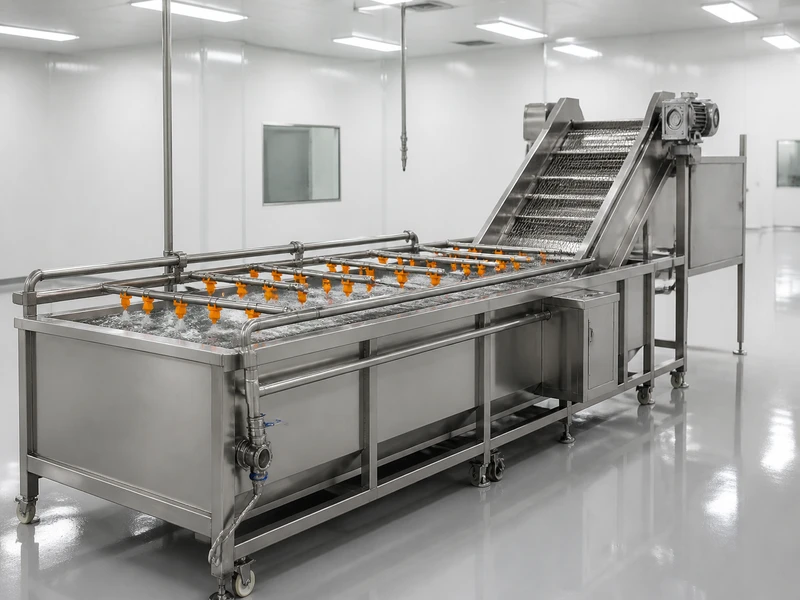
Air bubble washing utilizes a high-pressure blower that forces clean air through immersed diffuser pipes, generating vigorous boiling-like turbulence. This hydraulic action gently tumbles lightweight fruits and leafy vegetables (such as spinach, lettuce, berries, and herbs) without mechanical friction. Sand, soil, and heavy foreign particles settle into the bottom sedimentation cone, while surface bugs and leaves are skimmed off by circulating overflow filtration.
Q2: How does Vortex Hydraulic Flume Washing differ from Bubble Washing?
Vortex washing lines combine forward water currents with spiral spiral vortex flow. Fruits and cut vegetables travel through a continuous stainless flume where adjustable water jets produce a 360-degree helical motion. This ensures complete multi-angle sanitization, making it ideal for cut lettuce, diced onions, and sliced peppers where produce surfaces must contact water-soluble sanitizing agents (such as chlorine dioxide or peracetic acid) for a strictly calibrated dwell time (typically 60 to 90 seconds).
Q3: What makes Brush Roller Washers essential for Root Vegetables?
For root crops such as potatoes, carrots, ginger, and cassava, surface soil is often compacted into crevices and root eyes. Brush washing machines employ 9 to 13 counter-rotating wave-cut nylon brushes. Soft DuPont nylon brushes (0.2–0.3mm) provide deep cleaning without deskinning, whereas stiff emery-coated or abrasive bristles achieve continuous peeling and deskinning under high-pressure water spray manifolds.