
Industrial Drying Technologies for Fruits, Vegetables, and Bio-Productos
Drying is one of the oldest and most versatile food preservation methods. However, in modern export food manufacturing, processors must weigh capital investment, operating costs, and final market pricing when choosing between Vacuum Freeze Drying (FD) and Convective Hot Air Dehydration (AD).
Q1: What is the physical mechanism of Freeze Drying (Lyophilization)?
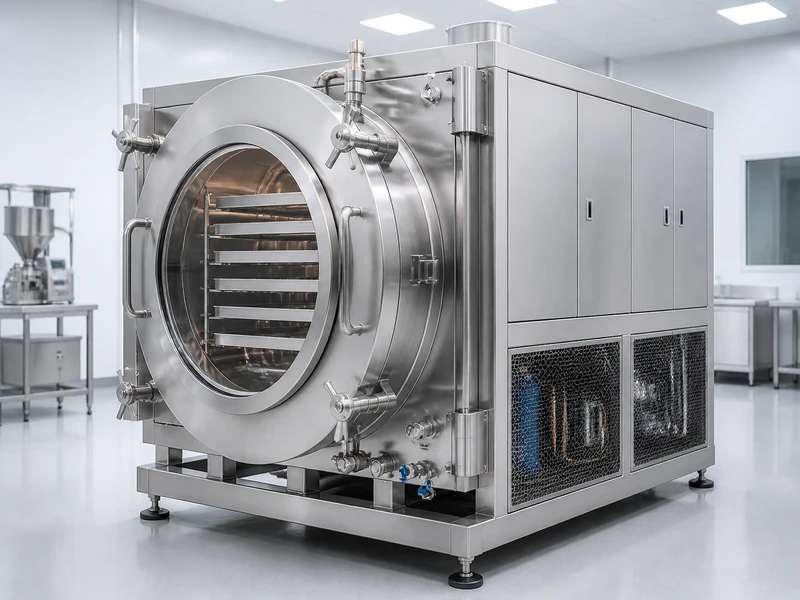
Freeze drying relies on the thermodynamic principle of ice sublimation under vacuum. Fresh produce is first pre-frozen in blast freezers to below its eutectic point (-35°C to -45°C) to lock free moisture into solid ice crystals. The material is then transferred to a vacuum drying chamber where pressure is reduced below the triple point of water (611.65 Pa). Heating plates supply sublimation heat, transitioning water directly from solid ice to water vapor without passing through the liquid phase.
Q2: What are the sensory and nutritional differences between FD and AD products?
Freeze drying retains 92%–97% of vitamins, natural colors, and 100% of physical volume with instant cold-water rehydration, making it ideal for high-margin healthy snacks and soup ingredients. Convective hot air drying operates at lower capital cost but incurs thermal degradation and shrinkage, best suited for industrial food ingredient bases.